The lighter side of teaching

“Looks like the National [White] Teacher of the Year awards are back in full effect. I figured (and may have even predicted!) in 2016 when three of the four finalists were teachers of color that pendulum would swing back quickly. ::heavy sigh::” 

Melinda Anderson

I came back with something flippant, along the lines of

“What will it take to make you people happy?”

It was meant as sarcasm, but I soon deleted it, because, well, I feared it might be misunderstood. Or maybe I feared it would be understood, a *wink wink* as an ally.

But here we are.

In 2016, three of the four finalists for the CCSSO Teacher of the Year Award were people of color.

Since then, all of the eight finalists have been white.

Of those, only two are even brown-eyed. (I’d be more specific, but I’m a tad color blind–in the physiological sense, not the I-am-better-than-you-as-a-non-racist *we* carry as our shield.)

This year’s finalists are all worthy. That is not the issue. That is not a defense.

TOTY Finalists, via Twitter (@ATLtrackclub)

And yes, the teaching profession has a remarkable lack of melanin and y chromosomes. (*We* pretend not to notice, unless you’re a black male teacher, in which case it is expected you will go save young black men.)

The finalists mean well, they do good work and work hard, and they fill the role of saviors that make for good stories. Still….

Listen up, *my* people.

Mandy Manning is the Washington State Teacher of the Year and one of this year’s finalists for the national award. She helps refugees adapt to life in the States, and talks about a boy from Tanzania who undergoes a remarkable transformation under her guidance. I have no doubt she is that good at what she does, and that she works hard at doing the right thing.

“District leaders, campus resource officers, community members of color, and professional writers have also visited my classroom. The visits help my students learn about school and city rules and laws, cultural expectations in terms of behavior and hygiene, our school system, and how to express themselves effectively.”  

On its face, that makes a nice soundbite, but it bothers me, because it’s what *we* do, what I have done, and what so many allies continue to do. That “community members of color” is separated from the others is telling.

What *we* teach becomes what we enforce:

So here we are. 

Our President of color replaced by a white man who supports white supremacy.

Our Teachers of the Year finalists are back to storybook savior roles.

We can all be colorblind again.

Why always a boy from Tanzania?
Do yourself a favor, and follow Melinda Anderson on Twitter.

In memory of her


Philipp Salzgeber, CC

She was a kid.

She was dying.
Everyone knew, and yet no one would say it.

Her mother asked that no one tell her child what was going on.

I saw her after her surgery, her head wrapped like a genie, sitting on her bed.

Her mother wanted me to promise I would not tell her.
I told the mother I would not lie if asked.

The comet hung in the sky like a jewel that summer 20 years ago.

It was evening.
I was tired.
The mother was tired
The child was dying.

I asked the other if I could take her child to a room where the comet was visible.
The mother said OK.
She did not come along.

I knew what I would say if the child asked.
The mother knew as well.

And the child never asked.

But she saw the comet.
The last one she saw.
Not the last one I saw.

And Hale-Bopp makes me sad every time I see a photo.

She never asked so she could protect the adults around her.

Industrialism and clams

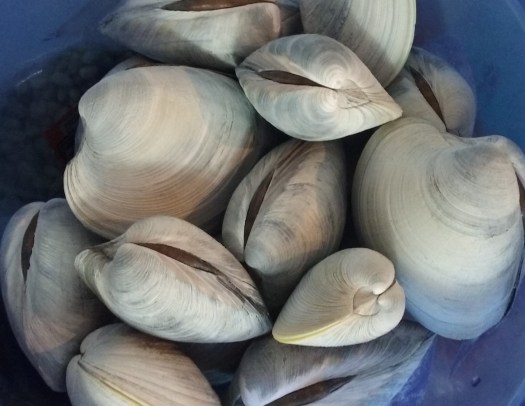
15 degrees Fahrenheit today–a bit too nippy to clam. The water temperature is down to 39 degrees–the clams are, well, clammed up now, waiting like the rest of us for this nonsense to pass.

Nothing new to write about on this first day of this new year. Clams eat, they grow. My rake resonates against one. I reach into the chill and scoop it up.

Never heard one say “Drat!”

***

Clamming by hand has a cost. I stir up the bottom with my rake, enough that fish will snoop in the area I just disturbed.

I occasionally impale critters not meant for the dinner table–I managed to spear two young horseshoe crabs on a bad afternoon clamming (though a worse day for them).

But I at least knew for a moment the creatures I wounded. Knowing didn’t make the agony of the broken horseshoe crabs any less painful, though they at least got a prayer as they sank to their deaths.

We got ourselves tossed out of the Garden a few thousand years ago–clamming is about as close to the Garden as I’m going to get.

I do nothing to deserve the clams, they just are.

I barely need to work to get them, they’re abundant at my feet.

I’m just close enough to wilderness to wonder what we lost when we decided to stay home and plant wheat 10,000 years ago.

I work over an area a bit over 500 square yards, and figure about 5000 clams live there. I’ll take about 10% of them this year, and next year 5000 clams will still be there, barring any ecological disaster.

Can’t think of a better definition of grace than that.

Undeserved love, but given anyway.

***

Rare clammers still make a living raking by hand. They know the critters like you know the sun.

Most clammers today dredge. Water is shot over the clam bed, creating a cloud of slurry, and the dislodged clams are dredged up to daylight.

The clammers will tell you they are oxygenating the water, feeding the fish, and at any rate, are not doing any permanent harm. Still, in a day when a clammer may take over 10 bushels (an old word), he’s not going to know one from the other.

The environmentalists will tell you that the bottom of the seas are being scarred, and maybe they’re right.

The few of us who can afford to live along the bay will complain about the early morning hours of the clammers, and eventually dredging in shallow waters is banned, and a few more clammers are out of business.

***

I know every clam I eat. I know where it lived. They don’t travel horizontally much, maybe a foot or two in a couple of years.

If ever I get sick from a clam, I can tell the DEP where it came from, withing a few dozen yards. (Not that I would ever tell them–I don’t sell my clams.)

Beyond the careless destruction of habitat, the sin of the industrial clammer is not knowing the critters he sells. Since most of us are industrial eaters, not knowing where our critters came from, I can hardly blame the clammer. He’s just making a living.

I can hardly blame the engineer who designs the hydraulic dredger, nor the driller at Exxon who mines oil for his boat, nor the construction woman who paved the ramp where the clammer launched his boat this morning.

No need to blame anyone or everyone, we are all complicit since we left the Garden. Grace does not dictate the market values, and we all have at least one person to feed, to shelter, to clothe.

***

You’re not going to find grace at Whole Foods–you’ll find fancy foods at high prices, and a few of the slaughtered beings there may have lived a slightly fancier life than their brethren at Perdue. But you still do not know them.

You pay for the privilege of a fancier form of industry, but you had to earn your dollars somehow. For most of us, earning cash requires participating in an industry.

To know grace you need to see the life drain from the creature you are eating.

Make a resolution to eat something you slaughtered, or at least grew.

Religion has fallen out of favor, and our industrial coccoons shield us from grace.

Grace is never easy, nor cheap.

But it is possible.

Photo of clammers by N. Stope at WeLoveClams.com

Photo of early Perdue farm via the Perdue website