It’s mid-November and the shadows are long–the sun slips over the horizon less than 10 hours a day now here in these parts.
It’s near dark when I walk home, crossing our town green, as I do several hundred times a year.
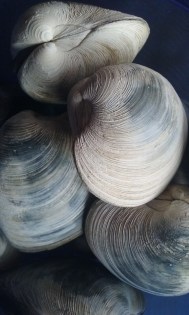
Clamshells in November light
There’s mystery in the shadows. Our ancestors saw spirits, and so will you if you lurk outside during dusk. The animals are aware of you, and so, I suspect, are the trees.
As winter looms, I watch the light change under my feet. (I look down a bit more now that I am getting older–the roots of the sycamore are determined to get me.)
But here is where words fail–when you walk at dusk over the fallen leaves, when it’s not quite light enough to see colors yet not so dark you cannot sense the colors, the edges of each leaf appear to glow as long as you keep moving.
No doubt there is some neuro-evolutionary advantage to this, some physiological explanation, some modern means of dispelling any reference to magic.
They’re alive, just an hour or two after leaving the bay, and will be until they are cooked an hour or two later.
I am alive when I take this picture, and will be even after these particular clams are eaten.
Quahogs raked from the back bay in late November
The air is chilly in the shadows, but the water is still warm enough for sandals.
In a generation or two, different clams will fill the same basket, different hands will hold the same rake.
The shells of the clams above now sit under a maple tree outside, resting among the shards of so many other shells, all raked up alive, all eaten, all dead.
If you’re a high school teacher, here’s a macabre exercise that I think is worth doing once or twice a year. Wander out into the hallways in between periods when the kids are being kids, in varied kid positions, using kid slang–walking, strutting, slouching, skipping. dancing, sliding with in your face vivaciousness .
Now imagine those same bodies a years after they are dead, their skeletal remains as lifeless as the ghostly white clam shells sitting under my maple tree.
Clam shells under the maple tree.
And then ask yourself, what are you doing today with these children whose lives are as mortal as the clams.
(Mortality should influence your curriculum at least as much as capitalism does….)
#SatChat question today–too often we ask ourselves questions without challenging the premises.
“Staying ahead of the curve” is adspeak used by an industry that needs you to keep turning over tools. The ed-tech industry runs on perceived obsolescence.
There is no need to get ahead of the curve (whatever that means) if one has the tools to do what is needed doing here and now.
Every tool has a learning curve. Every tool has limitations. Every tool used by humans is crafted by human imagination.
In anatomy, a few pieces of colored chalk are better than markers when using subtle shades to show specific structures. I no longer use chalk because I no longer have a chalk board–our administrators removed them years ago, perhaps to save themselves the embarrassment of falling behind the curve.
Anatomy art found in Honfleur, summer 2018.
I miss using chalk. This is not some romantic notion getting maudlin over days when I had more energy (and more hair). I can get by with more expensive Expo markers using a more expensive white board. (I could get by with a stick and a patch of beach.)
The tools most teachers use are tools thrust upon us by folks who have left the classroom, for whatever reasons.
Clams from the back bay, March 2019.
I clam with a fairly new (about 10 years old) rake with a wooden handle that replaced one about 50 years older. The style hasn’t changed much, but to be fair, neither have clams. There are bigger rakes, there are rakes with baskets, there are rakes with Fiberglas handles, and for all I know there may be rakes with built-in GPS systems.
I could pluck clams from the mud by hand, I suppose, and some days I do just that. There is joy in clamming by hand, even if it lacks the efficiency of a commercial clam dredge.
I traded that curve years ago for the arc of the sun settling on the edge of the bay and the feeling of the arched back of a quahog in my hand.
If you’re ahead of the curve, drop a comment and let me know what I am missing.